









BY JOY OFASIA
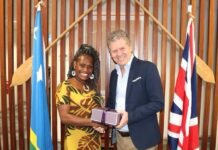
After two years [2024 to 2026] of service in Solomon Islands, former U.S. Embassy Honiara Public Affairs Officer Kristine Marsh is bidding farewell to a country she says will forever hold a special place in her heart.
As the first Public Affairs Officer assigned to the U.S. Embassy in Honiara following its elevation from a Consular Agency to a full Embassy in 2023, Kristine played a key role in strengthening people-to-people ties between the United States and Solomon Islands. During her tenure, she helped establish the Embassy’s Public Diplomacy Section, expanded educational and cultural exchange opportunities, strengthened media engagement, and fostered partnerships with government institutions, communities, and development stakeholders across the country.


In this exclusive interview, Kristine reflects on her personal journey into diplomacy, her experiences working in Solomon Islands, the achievements and challenges of her assignment, and the meaningful relationships she built along the way. She also shares her observations of Solomon Islands society, the role of women in shaping the nation’s future, the importance of development partnerships, and her hopes for continued cooperation between the United States and Solomon Islands.
As she concludes her diplomatic posting, Kristine offers insights gained from a career dedicated to building international understanding and leaves a key message for Solomon Islanders and future development partners seeking to contribute to the country’s growth and prosperity.
1. Could you share a bit about your personal journey and what initially drew you to your current field of work, and what has it been like working under the embassy?
Thank you for this question, which is one of my favourites, both to be asked and to ask of others. It’s a great way to get to know someone. “Getting to know someone” is why I joined the U.S. Department of State. I grew up in a rural area outside of Chicago. Chicagoans are known for friendliness and for their welcoming nature, and after World War II, exchange programs for high school students began to crop up in earnest. Many exchange students came to the Chicago area, and they continue to come. When I was in the equivalent of Year 3, an exchange student from the Netherlands made a presentation to a club for kids in farming communities that I belonged to. This presentation made a huge impact on me. I studied some Spanish in Year 8 and started French the next year. I spent a month in France after a couple of years of studying the language. Then, I won a scholarship that provided me the opportunity to spend my last year of high school in Germany, where I learned the German language and got to understand the German people. In university, I studied the Russian language and spent a semester in St. Petersburg. In each of these countries, I found that “getting to know people” was the most important factor to motivate me to improve my skills. This is a philosophy that I have carried with me at each post I have served at. Here in Honiara, while we are a small team at the U.S. Embassy, we have grown together over the past two years that I’ve been here, which has been fulfilling and exciting. It also makes me sentimental as I have come to love Solomon Islands and Solomon Islanders, and I am already missing everyone I have come to know, including contacts at ministries, journalists, alumni of U.S. government programs, and fellow diplomats and counterparts at development organizations.


2. What has been the most rewarding aspect of your professional endeavours so far, especially during your tenure here?
I have to say that setting up our Embassy’s Public Diplomacy Section as the first Public Affairs Officer assigned to U.S. Embassy Honiara has been the most rewarding assignment of all of my assignments in the State Department. I knew that I was handed a very important task, and with that came much responsibility. When I arrived in April 2024, most of our staff were new to the State Department and to the U.S. Embassy. I feel that providing a supportive work environment to our local staff is very important, and because everyone was new, the team lacked State Department-specific knowledge. To bridge those gaps, I helped our team make linkages with counterparts in U.S. Embassies and Consulates around the Indo-Pacific and found various training opportunities. I shared our professional culture of “One Team” – we help and support one another, always. Besides that, we have worked on the basics of any Public Diplomacy Section. Our first priority was to find some incredible Solomon Islander professionals and students to participate in our exchange programs. Beyond that, we built the U.S. Embassy Honiara website, instituted a plan to attract new fans to our Facebook page, met and liaised with all of the media, started a collaboration with Solomon Islands National Museum, started official visits to the provinces, welcomed three groups of Fulbright English Teaching Assistants, and started a new alumni association for alumni of U.S. government programs. There have been other programs and events that we have hosted and let the Solomon Islands public know about on our social media platforms and in press releases we sent to the media. When I first arrived, many people were not aware that in 2023, we transformed the U.S. Consular Agency into the U.S. Embassy in Honiara – so we got the word out about that. This is a special year – 2026 marks the 250th anniversary of the world’s longest continuous democracy – the United States of America, and we are celebrating “Freedom 250” with our Founders Museum, which all school, church, and community groups are welcome to visit. We had a lot of fun launching it when U.S. Deputy Assistant Secretary of State Matt Murray visited from Washington, and I know that the team cannot wait to host other visitors throughout the year!
3. What were your first impressions upon arriving in the Solomon Islands, and how have those evolved over your two-year assignment?
My first impressions of Solomon Islands were vast as everything that I saw and heard was so new to me! My previous postings include Kyrgyzstan and Turkmenistan (in Central Asia), Hungary (in Europe), and Senegal (in Africa). I also worked in the Department headquarters in Washington, DC. You can imagine from my background that I had not ever dreamed of serving in the Pacific, so when I arrived in Honiara, I realized that this was an opportunity to put all of my Public Diplomacy skills to work. Laying the bricks for a solid foundation was my first priority. But then, meeting those incredible Solomon Islander professionals and students I mentioned gave me a clear impression that I would have a very special experience in Solomon Islands. Also, it was also clear that Solomon Islanders admire the United States and all of our accomplishments throughout the years. We appreciate this and recognize that Solomon Islanders have a great respect for the United States. It is undeniable that Solomon Islanders want to have a closer bilateral relationship, including people-to-people ties but also economic and trade connections. All of this is possible, if we work together closely and in a spirit of partnership – and what Hawai’ians would call a spirit of Aloha.


4. What are your thoughts on the people of the Solomon Islands?
I came to enjoy walking around Honiara and loved seeing the town from the perspective of a pedestrian. It was fun to hear later that my friends and colleagues saw me walking, too! That brings to mind the community nature of life in Honiara. We all run into one another on a regular basis, and there is something wonderful about that. In addition, I encountered people I’d never met before – all of whom would smile at me! And then I came to realize that these walks were a way for me to experience the Hapi Isles right in the middle of Honiara – and I really liked it! I left Honiara a few weeks ago feeling humbled by the incredible warmth, care, and generosity of Solomon Islanders. I formed many partnerships over the past two years and was impressed by the creativity, resilience, and determination that many Solomon Islanders display. I think that there is a determination to connect with myriad partners, and I was gratified that so many of our exchange participants took the opportunity we provided them so seriously.
5. In what ways do you believe contributing to the lives of local communities creates a lasting impact?
The Millennium Challenge Corporation-Solomon Islands Threshold Program (MCC-SITHP) is a $20 million USD grant from the American people designed to advance the economy of Solomon Islands. MCC has recently been engaging with Western Province communities to clarify land ownership and support the transfer of Perpetual Estate titles. This is aimed at preparing communities for future tourism investment. This is practical and hands-on support that will not end after one meeting, and can clearly have a significant, lasting impact on local communities. Another MCC project I would like to mention is a carbon finance project for forests in the Yato Conservation Area. Forest resources have value beyond the timber itself, and this project spans nearly 10,000 hectares of rainforest is yet another example of a practical, environmentally sustainable project that is improving local communities many-fold, following more than 10 years of negotiations. In my experience around the world, extending a hand to communities in their time of need has potential to make a significant difference. We are proud to have been able to support communities affected by Tropical Cyclone Maila with critical assistance that helped ensure they could meet the most basic of needs, such as clean drinking water. You will notice a common theme in every one of these projects: impact. It has become critically important in the U.S. government that all of our assistance has a clear and lasting impact, both to these local communities and to the United States. An example of this is the U.S. International Development Finance Corporation or DFC’s Investment Incentive Agreement that our two governments just signed. This initiative will open the door to new private sector-led transactions that have clear potential to transform the Solomon Islands economy and improve the lives of Solomon Islanders, while also strengthening U.S. economic engagement in the Pacific. Agreements like this one can make both of our nations safer, stronger, and more prosperous.


7. What observations have you made about the women in the Solomon Islands, and what role do you see them playing in the nation’s future?
As I have travelled around Solomon Islands and interacted with those in ministries; media, education, and other sectors; and church communities, I have had the extraordinary privilege of getting to know Solomon Islands women who have strengthened their families, enriched the culture, defended Solomon Islands values, and pioneered industries – and are now shaping Solomon Islands’ future. President Trump said in commemorating Women’s History Month this year that “Whether they serve our Nation as service members, government leaders, entrepreneurs, or mothers, every devoted woman guides our Nation’s strength, prosperity, and way of life.” The same is true of Solomon Islands women, many of whom I am proud to call my friends. I will pray that the legacies of Solomon Islands women will inspire future generations of citizens to strive for excellence, lead proudly, and carry forth enduring Solomon Islands values. Women contribute in many ways to the greatness of our economies, communities, and countries. I support recognizing – and – celebrating that.
8. What are some of the most cherished memories you’ve made during your time in the Solomon Islands?
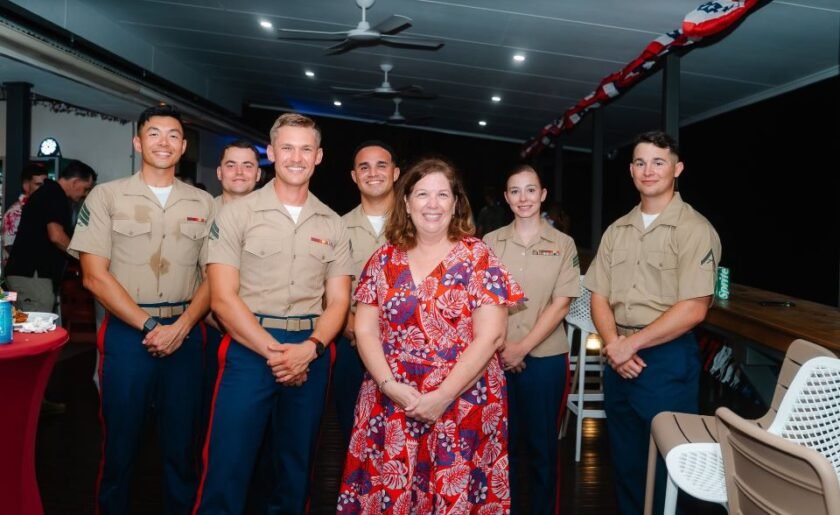
So many memories come to mind. Professionally, I would say that my favorite experience was welcoming U.S. Deputy Assistant Secretary of State Matt Murray to Honiara. Betikama Adventist College gave the Deputy Assistant Secretary a welcome like I have never seen before! It was an incredible afternoon and absolutely unforgettable. We also thank SIBC for the interview of the Deputy Assistant Secretary and the alumni for coming out to see the Founders Museum and help us launch it. I have other Favorite memories of life in Solomon Islands, too. Being a member of Holy Cross Cathedral was a very important part of my life. I appreciated the many friends I met at Holy Cross, and seeing all of the good work done there. It was a tangible tie between my family and home country and my diplomatic service in Solomon Islands. Of course, one cannot talk about living in Solomon Islands without mentioning travel outside of Honiara, and to the provinces. Visiting Auki was very important in order to make those contacts. Tulagi and Roderick Bay were also very special. I was lucky to snorkel at Mbonege Beach many times. Visiting Papatura in Isabel Province was absolutely amazing! The people of Solomon Islands are surrounded by natural richness. I thought about this every day when I would wake up and hear birdsong outside of my window and the waves crashing. God bless Solomon Islands!

9. Looking back, what is one significant lesson you’ve learned from your experiences in this region and working in diplomacy?
If I have one regret about my assignment in Solomon Islands, it is that – amidst all of the things I was able to accomplish – I know there is more to do. We had some great ideas, and we had plans to launch them, but time did not suffice. However, I was able to set some new programs and projects in motion and you’ll be hearing about them in the months ahead – stay tuned for news about them!
I have to say that none of what we were able to accomplish over the past two years would have been possible without the assistance of our Public Engagement Assistant, Raywin Taroaniara. I’m glad that Raywin has and will be with the U.S. Embassy – our local staff is so very important, and Raywin is a clear example of that! Concerning diplomacy, the wisdom of the American writer Maya Angelou has guided me throughout my career, specifically this quote: “I’ve learned that people will forget what you said, people will forget what you did, but people will never forget how you made them feel.” In my opinion, the best diplomats combine their professional tradecraft, patriotic loyalty, local knowledge, curiosity, and other attributes with their authentic selves. This is what I have always tried to be and project, and I am glad that it seemed to work well in Solomon Islands.
10. As you bid farewell, Kristine, having been instrumental in expanding people-to-people exchanges four-fold, what message would you like to share with those considering engaging with or supporting development efforts in the Solomon Islands through diplomacy assignments?


I would like first of all to provide my recommendations to Solomon Islanders who wish to participate in U.S.-sponsored programs. The U.S. Embassy would love to expand its people to-people exchanges even more, and it is in that spirit that I would like all of your readers to know that we post all exchange opportunities regularly on our Facebook page (@USEmbassyHoniara) and on our website. If you look at https://sb.usembassy.gov/exchange-programs/, you will see a complete list of programs that are available to Solomon Islanders. Those that are open for applications will be at the top and will have deadlines listed. You can check out this information anytime you have access to the web. I recommend that anyone who is interested in participating in U.S. exchange programs – and we have some for high school students, teachers, university students, university graduates, aspiring master’s students, and others – a) follow our Facebook page and b) check out our website! Do a bit of research in advance so that you have an idea when our application season will be. As I mentioned earlier, starting something new takes time. The base has been built, and I predict a strong house will stand on top of it! I have found that conversations with our government and non-government partners have been most fruitful because it is through those discussions that we can find out how we can turn development assistance into a development partnership – and that is key. Thank you very much for the invitation to take part in this interview. Being U.S. Embassy Honiara’s first Public Affairs Officer was the honor of my career. My service in Solomon Islands turned out to be even more impactful and fulfilling than I ever expected it to be! Solomon Islands will forever be in my heart, my mind – my soul.